A few words about me
Before I get into it, I owe you a little background. I'm Konstantinos Malakis, one of the three cofounders of Rhooa Labs.
I finished my studies in the Electrical and Computer Engineering department of Democritus University of Thrace, specialising in energy.
During that time I came across the methodologies of machine learning, the neural networks that felt familiar to me because they are governed by mathematics, and mathematics is simple if you understand it.
In the last few years I've been studying and discovering the capabilities of artificial intelligence, and how a single person can produce something useful out of it. My approach, however, isn't a research one but a practical one; I think and act like an engineer. Something has value when you build it and it works, when it relieves pressure, when it helps.
That's my background ιn reality though, none of that matters that much. What does matter is this: through that path, I've come to understand that people without an academic background carry a blurry, almost mystical picture of what Artificial Intelligence really is.
And that's a problem. Not theirs. Ours.
Why I'm writing this series
When I sit down with a client for the first time, we usually end up at the same lines:
"It's not even good for writing an email"
"I don't understand how it would help me"
"I'm not sure if it's for me"
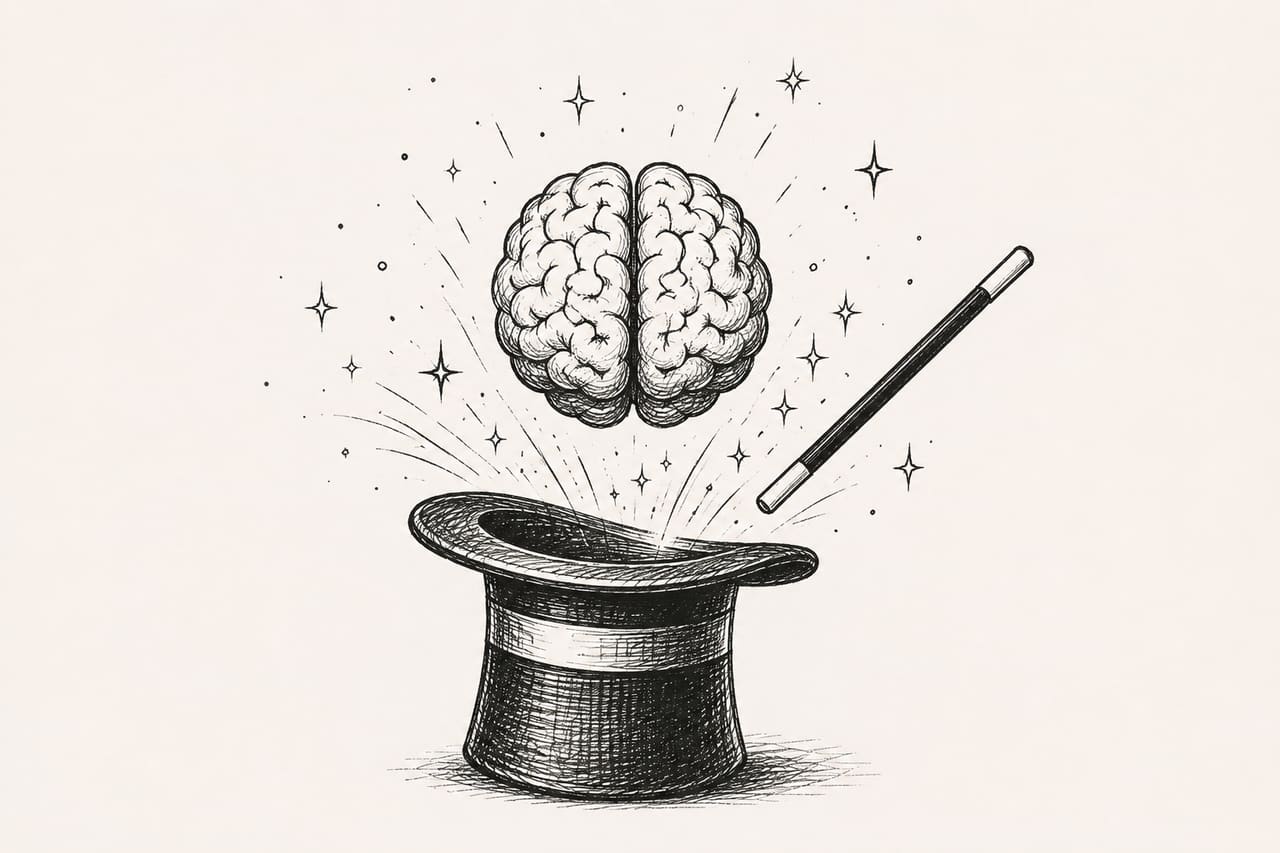
They're right not to understand. The way AI is presented today, in ads, in news, in LinkedIn posts, is designed to feel magical. Because when something feels magical, it makes you doubt your own judgment. And that suits the people who want to sell you tools before you understand what you're buying.
This series is not a sales pitch. I won't be selling you anything. I'll try to show you what Artificial Intelligence actually is, honestly, with references, with examples from my own work, so that by the end you can make your own decisions.
What AI (really) is
Let's start with the most important sentence: AI is not magic.
It doesn't think. It has no consciousness. It doesn't want anything.
AI, in the form it has today, is maths, plus data, plus compute.
Specifically: a set of techniques from statistics and theory of computation that, when trained on large enough datasets, can recognise patterns. That's its one and only "superpower": pattern recognition at scales that feel impossible to a human.
When ChatGPT "writes" a piece of text, it isn't thinking. It calculates, word by word, the most likely next word based on the billions of texts it was trained on. When a car "sees" a pedestrian, it doesn't understand the pedestrian. It has learned to recognise the figure of a human body across millions of labelled images.
It is impressive, genuinely. It is not magical.
A look back
The idea of Artificial Intelligence isn't new. It's over 75 years old.
In 1950, Alan Turing wrote a paper titled "Computing Machinery and Intelligence", where he proposed a question that still haunts the field: "Can machines think?". He didn't give us an answer. He gave us a test, the Turing Test, so we could discuss the question seriously.
In 1956, a small conference at Dartmouth College officially gave birth to the term "Artificial Intelligence". The researchers thought we'd have machines that think like humans within a single generation. They were wrong, by a wide margin.
Two AI Sprints followed: periods when the field was overfunded, promised even more, and then collapsed for lack of results. It's a story that could easily repeat itself today. Something to keep in mind.
The modern AI era didn't start with ChatGPT. It started in 2012, when a system called AlexNet won the ImageNet image-recognition contest by a huge margin, using a technique called deep learning. From that point on, the field exploded.
In 2017, the paper titled "Attention Is All You Need" from researchers at Google introduced the Transformer architecture, which is the foundation of every modern LLM.
Everything else, ChatGPT, Claude, Gemini, Llama, is an application of that foundational idea.
What AI is NOT
Before we go further, let's clear up what it isn't. The magic starts here, and here is where it has to stop.
- It is not AGI: Artificial General Intelligence, an AI that can do anything a human can, does not exist. No matter how hard certain CEOs try to convince us otherwise.
- It is not unreliable because it "thinks differently": it is unreliable because it is probabilistic. It doesn't actually know what it knows.
- It is not "intelligent": it is good at pattern recognition. Those are not the same thing.
- It is not ready to replace humans: it is very good at speeding up processes. The difference is enormous.
What's coming in the rest of the series
This series has one goal: to give you a calm, honest picture of what AI is and what it can or can't do for you.
This isn't a programming course. It's a conversation between two people.
In the next articles we'll cover:
- How an AI system learns: training, data, the limits.
- What LLMs really are: ChatGPT, Claude, Gemini, and how they actually work.
- Where AI fits in a business: concrete examples, no hype.
- The myths and the worries: jobs, privacy, the EU AI Act.
- How a business starts with AI: properly, without wasting resources.
- The future: what to watch, what to ignore.
If you want to follow along, thank you in advance. If you have questions as we go, send me an email →. I read every email and I'll answer personally.
To close, you don't need to become an expert. You just need to understand enough that nobody can sell you a fairy tale.
Welcome.