Picking up where we left off
In the first article of this series we said that AI isn't magic. It's mathematics, plus data, plus computing power. If you haven't read it yet, I'd suggest starting there. The rest of the series builds on that foundation.
Today we'll look at something more interesting: how exactly does such a system learn? Not at the level of equations. At the level of intuition. I want you to leave with a clear picture in your head, not jargon.
Forget the brain
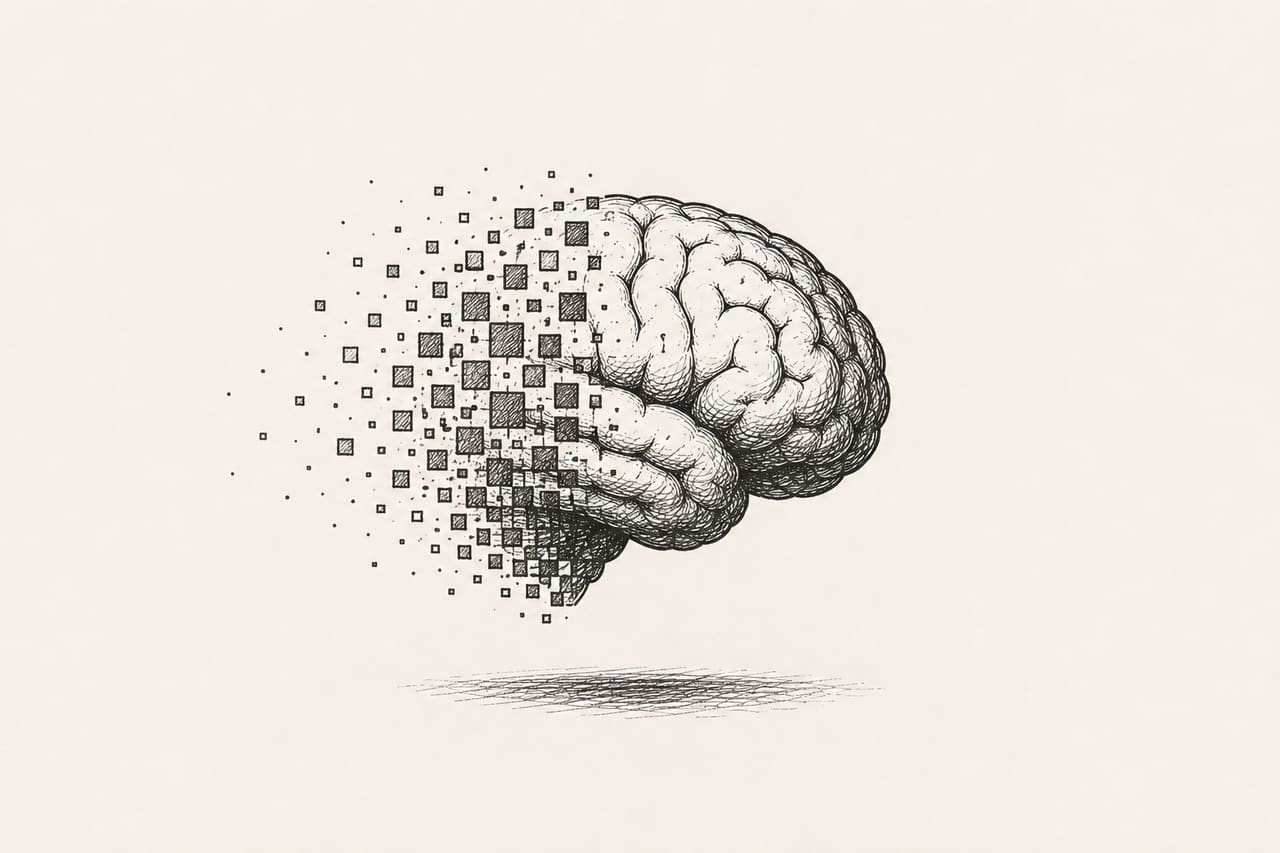
The comparison "AI thinks like a brain" is convenient for news headlines, but it confuses more than it explains. It won't help you.
I'll use a different picture. Imagine a huge board covered in knobs. Millions of knobs, each one can be turned to any position you want. This board is the model.
When you feed the system an image of a cat, the image travels through all those knobs and at the end an answer comes out: "cat", "dog", "car".
At the start, the knobs are in random positions. So the answer is random.
Training is the process of finding those knob positions that, after millions of images with correct labels, produce the right answers most of the time.
There is no "learning" in the human sense. There is optimization.
How the knobs turn
The basic idea is this:
- You show the system an example. Say, a picture of a cat.
- The system guesses. At first randomly.
- You measure how wrong the answer was.
- You turn the knobs slightly in the direction that reduces the error.
- You repeat millions of times.
This process is called gradient descent, and it's the core of every modern neural network.
What's strange, even to me after studying this for years, is that it works. Despite billions of knobs, despite the non-linearity, this process actually converges on solutions that generalize to new data.
Why does it converge? We don't fully know yet. It's one of the most active research areas in machine learning theory. Some of the most important papers of the last few years are trying to explain why deep networks generalize so well. It's not a solved problem.
I'm not saying this to worry you. I'm saying it so you know. When someone tells you with confidence "AI thinks like this," remember that even the researchers themselves don't have a complete answer.
Data is the real superweapon
This is where I want to stop. Because this is the part almost nobody tells you.
A model is only as good as the data it was trained on. If the data is biased, the model is biased. If the data is incomplete, the model is incomplete. If the data is noise, the model is noise.
It's not a cliché. It's the first law of machine learning: garbage in, garbage out.
To see why this matters to you, consider this:
ChatGPT is trained on trillions of words from the internet. The overwhelming majority of those words are in English.
When you write to it in Greek, it works. But not as well. It has seen a hundred times less Greek text than English. So it has built a weaker representation of Greek.
And you can see it in daily use. In Greek it makes more grammatical mistakes, misses expressions, sometimes changes accents for no reason. It's not "stupidity" of the model. It's a lack of data.
The same goes for any specialized domain. If you want an AI that knows your business, you have to give it your business data. Otherwise it only knows the average of the internet.
The limits nobody tells you about
This is the part I care most about. Because these systems have serious limits most people ignore.
-
Distribution shift: if the model was trained on cats and dogs and you show it a horse, it won't know what to do. The same applies to any out-of-distribution input. In practice, if you train a model on Athenian Greek, it may not work as well on Cretan dialect.
-
Hallucinations: LLMs do not produce truth. They produce probabilities over the next word. When they don't know, instead of saying "I don't know," they produce something that looks correct. This is called hallucination and it is the biggest problem modern AI has for business use.
-
Bias: if the training data carries bias, so does the model. It has been shown again and again. Hiring systems that reject female candidates. Face recognition systems that work worse on darker skin tones. The model is simply reproducing what it saw.
-
Cost: training a frontier model like GPT-4 or Claude costs over 100 million dollars. That number isn't dropping anytime soon. It means very few companies in the world can build such models from scratch.
-
Energy: a data center that trains AI consumes as much power as a small city. It's a problem nobody wants to talk about seriously.
What this means for your business
Enough theory. What do you take from all this if you run a business?
First: don't expect AI to know your business. It doesn't. It knows the average of the internet. If you want specialization, you need to feed it your own data, using techniques like RAG or fine-tuning. We'll cover those later in this series.
Second: don't trust its answers blindly. Always have a human reviewing critical decisions. If you let a model write emails to clients without supervision, at some point it will write something wrong. Not because it's "bad." Because that's how it works.
Third: start small. Test in low-risk spots first. Note summarization, email classification, internal document search. Not autonomous client communication on day one.
Fourth: ask how was it trained about the tool someone is selling you. On what data. How recently. In which language primarily. If the salesperson can't give you a clear answer, that's not a good sign.
What's coming in the next article
In the next article in the series we'll talk about LLMs: ChatGPT, Claude, Gemini, Llama. How they work, how they differ from each other, and how to pick the right one for your case.
As always, if you have questions along the way, email me →. I read every email and reply personally.
Thank you for following along.